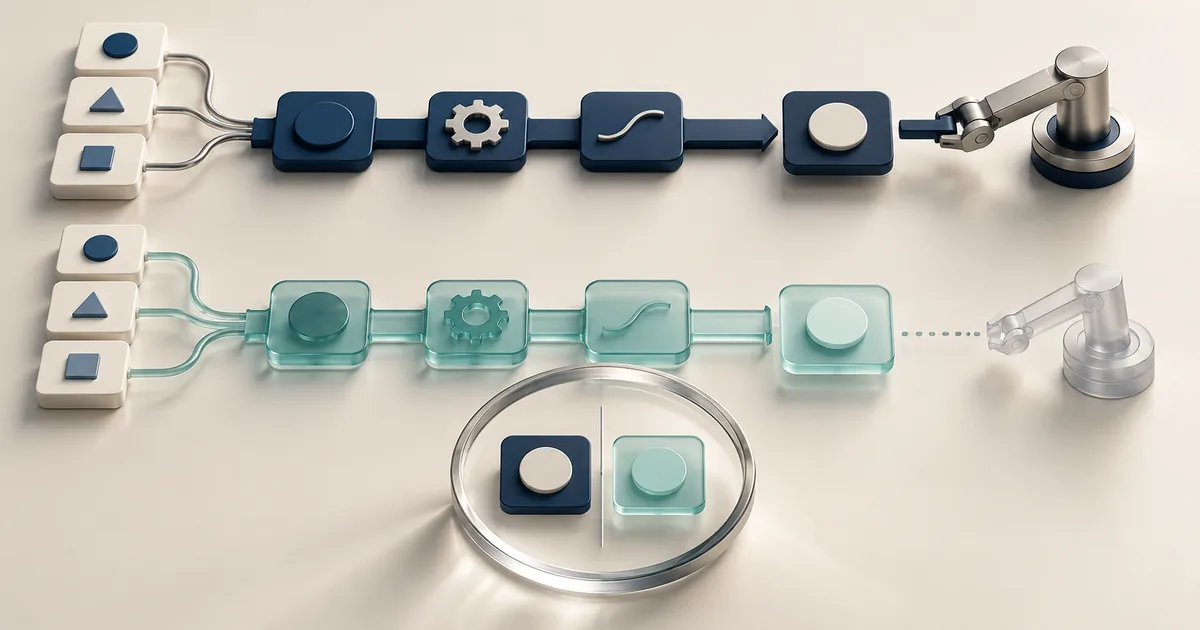
Can an AI workflow be tested against live work without letting it change a live record? Shadow mode provides a disciplined way to find out. The established process continues to serve the customer and remains the only source of operational actions. In parallel, the proposed automation receives an authorized copy of each selected input, produces a recommendation, and records it for comparison. It cannot send a message, approve a request, change a case, or trigger a downstream tool.
This is especially useful when a promising demo has not yet faced incomplete forms, unusual exceptions, peak-hour load, or conflicting data. A shadow run cannot prove that a future rollout will be flawless. It can reveal where the design is unsafe, how often human review is needed, and whether the benefits justify the operating cost. The question is not merely whether the AI agrees with the current process. It is whether the organization can explain disagreements and act on them responsibly.
What shadow mode tests
In a shadow run, the production path handles the request as usual. The candidate system processes the same permitted input independently. Its output, latency, failure reason, and version are captured for analysis, while the production path alone determines the response and side effects. If the candidate can write to the production database or invoke a real external action, it is no longer safely isolated, regardless of what the UI calls it.
This concept is familiar in model serving. AWS's official shadow-testing documentation describes sending a copy of live inference requests to a shadow variant while the production variant's response is returned to the caller. That service-level example does not automatically protect an end-to-end business workflow. An automation may call tools, update a queue, or send notifications after inference. Those permissions and connections must be blocked and tested separately.
A useful test therefore measures more than label agreement. Two systems may choose the same category but different next steps. Conversely, the human decision in the current process may itself be wrong. Define the proposed decision, its hypothetical operational consequence, and the evidence used to judge it before collecting results.
Draw a hard boundary around side effects
Start by mapping every action the workflow can take: create or modify a record, issue a document, send email, route a ticket, charge an account, change access, or call a third-party service. For each action, determine what the shadow component needs to observe and exactly where real execution will be denied. Hiding an action button is insufficient when an API, event consumer, or AI tool can still perform the action.
A practical separation has three layers. An intake layer copies only eligible inputs. A candidate layer computes a recommendation with independent timeouts and resource limits. A comparison layer stores a proposed action in a test-only destination. That destination has no route back to the live operational queue. If the candidate needs to inspect reference data, use authorized read-only access or a suitably protected snapshot. Record the freshness of snapshots; stale reference data can create false disagreements.
Failure isolation matters just as much as write isolation. A slow model, exhausted quota, failed log store, or full analysis queue must not delay the live customer response. Test that the production path continues when the shadow service is unavailable. Give the shadow path its own stop switch, capacity ceiling, and incident owner. A design that makes the real workflow wait for an experimental recommendation has already changed the risk profile of production.
Choose representative inputs and limit data exposure
Live traffic is not blanket permission to duplicate all customer information. Set the purpose, access rules, retention period, and deletion method before copying data. Pass only the fields needed for the candidate decision. Separate a comparison identifier from personal identity where feasible. Review whether attachments, contact details, and free-text notes contain information the candidate or its provider does not need.
Sampling should reflect the work that the future system would actually handle. Include incomplete requests, ambiguous Persian wording if that is part of the product, conflicting fields, cases reopened after a decision, sensitive customers, and dependency outages. Assess slices separately. A high overall agreement rate can conceal a weak result for a small but consequential group. If a slice has too little evidence, mark it unresolved rather than silently treating it as successful.
Keep the prompt, model or ruleset version, reference-data version, and eligibility rule with each recorded recommendation. Otherwise, a comparison across two weeks might combine different systems under one label. The related guide to versioning automation rules addresses how to distinguish a changed rule from a changed outcome when live logic evolves.
Treat disagreement as a review queue, not an error counter
The existing process is a comparator, not an infallible ground truth. Staff can make mistakes, and an old rule can be inappropriate for a new case. When paths diverge, route the case to a qualified reviewer who can inspect the underlying evidence and apply a written decision standard. Where possible, show the case first and reveal which recommendation came from which source afterward; this reduces source-based bias.
Design evaluation criteria in advance. For routing, they might include the appropriate destination, required human escalation, completeness of extracted details, processing time, and severity of a possible wrong action. Distinguish a harmless correction from a delay that requires intervention and from an action that should never be automated. The process owner, not a generic benchmark, must decide which differences are acceptable.
The hypothetical action must be traceable beyond the model's category. Record what queue, authorization boundary, or case status would have changed if the recommendation were enabled. The separate article on auditing automation results at the destination becomes particularly relevant once actions are real; in a shadow run the team is examining the projected effect before making that transition.
Example: routing purchase requests
Imagine a procurement team that currently assigns incoming purchase requests through staff review. An AI candidate reads the request and approved fields from its attachment, then recommends a processing route. During the shadow period, the live request is still assigned by staff. The candidate records a proposed route, inspectable rationale, and whether it would ask for human review. Its record cannot update the actual assignment.
The team examines differences case by case. Did the model have a field the reviewer did not? Was the request incomplete? Did it interpret an ambiguous phrase too confidently? Would the proposed destination have access to an attachment it must not see? Even a topically correct route is unsafe if it crosses an access boundary.
Suppose normal requests look good but multi-stage purchases repeatedly miss an approval step. Adding more easy requests to inflate an overall score would not resolve that weakness. Keep multi-stage cases under human control, correct the design, and retest that slice. A first deployment might show the recommendation to a reviewer while leaving the final assignment decision with that person. The same shadow evidence can support a narrower, safer release than the original plan.
Measure operational fitness as well as decision quality
An accurate recommendation is not useful if its latency, per-case cost, or error recovery is unsuitable for the actual workload. Record model calls, retries, queue time, service failures, and the human time needed to review uncertain cases. Compare quality and cost over the same traffic mix. A short trial is not a universal savings estimate; seasonality, request complexity, and volume can change the economics.
Logs should allow a team to reconstruct a disagreement: correlation ID, time, logic version, input category, recommendation, escalation reason, and final review outcome. Retain sensitive content only under the organization's approved rules. Conversely, a test with unreviewable output records may produce an attractive chart but insufficient evidence for a deployment decision.
Set an exit gate before the trial starts
The process owner, technical owner, and data owner should agree on the decision gate in advance. Which case types require coverage? Which failure classes cannot be accepted? How much manual review is operationally feasible? What incident stops the test? Numeric thresholds should come from the risk and evidence of this workflow, not an arbitrary number copied from an article. “Run another targeted test” and “do not automate this step” are legitimate outcomes.
If the evidence supports a release, increase authority in stages. Consider an advisory display for staff, then controlled execution for a low-risk slice with explicit approval, then wider operation with monitoring. Each stage needs an accountable owner, a stop mechanism, and a way back to the previous process. Input forms, policies, and user behavior will change after the trial, so ongoing monitoring is part of the system. When evaluating EasySaz AI services, include those operational controls in the scope rather than judging only a model demonstration.
A practical next step
Shadow mode turns the gap between a demo and real authority into an auditable experiment. It copies eligible inputs, contains proposed actions, reviews disagreements by consequence, and makes rollout conditional on evidence. Its value is often in revealing what a tidy test set omitted: missing information, unauthorized destinations, rare exceptions, dependency failures, and real operating costs.
Before choosing a tool, map one workflow's input, side effects, review rules, and acceptance gate. If you want to design a scoped shadow pilot around your own process, describe the workflow and its constraints through EasySaz contact.