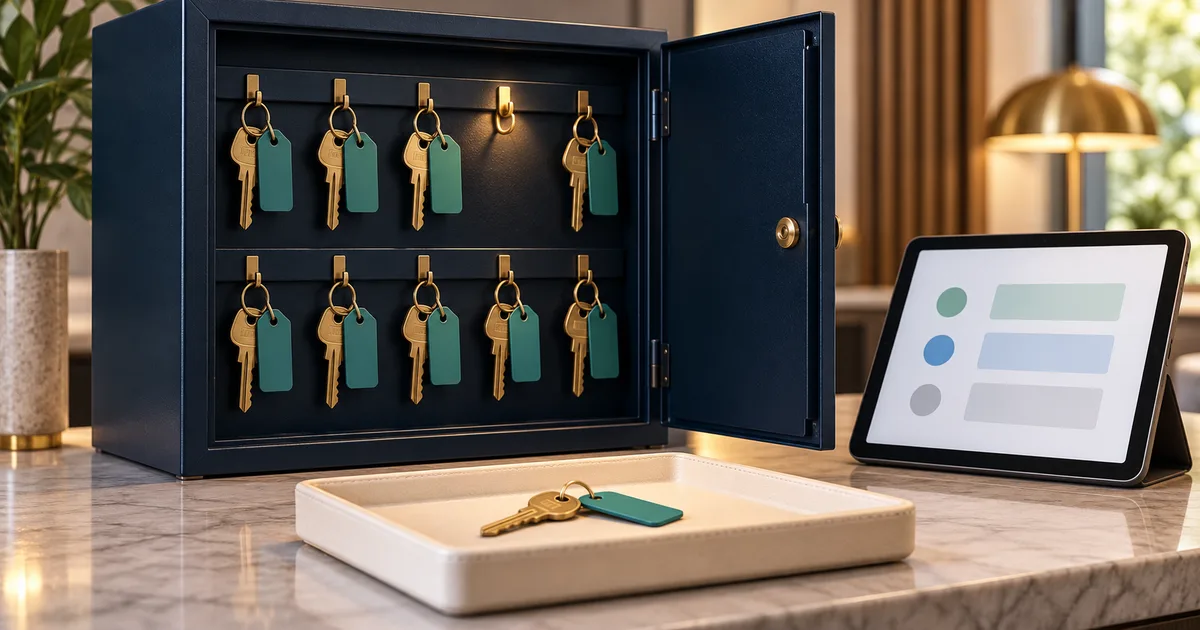
Physical key management software should identify who currently holds each key copy, why it was issued, when it is due back and what happens when the record does not match reality. A spreadsheet of recipients alone is not enough. Authorization, actual handover and the state of each copy need separate records. Returning one key also does not prove that no additional copy exists.
This guide covers ordinary physical keys used for rooms, stores, cabinets and technical areas—not encryption keys or application passwords. It defines practical custody requirements without suggesting that software replaces secure storage, suitable locks or decisions by the responsible security team.
Why this differs from equipment booking
Equipment booking primarily allocates use of an item over time. A key enables access to another space or asset, so the consequence of losing it can exceed its replacement price. A master key may affect several locations and should not be treated as an interchangeable low-value item.
For scheduling shared tools, the equipment booking software guide addresses a different intent. Key custody additionally requires copy-level identification, access scope, storage responsibility and incident handling. Similar-looking checkout forms should not obscure those differences.
Identify individual physical copies
Three keys that open the same door are not one custody record with a quantity of three. Each issuable copy needs an identifier so the organization can distinguish the copy in storage from the one held by an employee.
Record the key type, copy, normal storage location and status. Limit visibility of the relationship between keys and accessible locations. A tag can identify the copy without openly advertising sensitive location details. Avoid collecting detailed key-cut images or fabrication information without a justified need and appropriate protection.
Reconcile the starting inventory against physical observation. Old lists can include missing, retired or unaccounted-for copies. Mark discrepancies for investigation rather than importing them as confirmed available stock. An unresolved opening balance will otherwise undermine subsequent handovers.
Separate permission from possession
An approved request is not evidence that the key was collected. Model request, authorization, actual issue and return as distinct events. A person who never arrives should not appear as holding a key merely because their request was approved.
Define the scope and validity of permission. Does it cover one copy or any eligible copy of a type? Is collection restricted to a shift? Does a contractor require an internal escort? The process owner must establish these rules; software should not invent permissions from a job title.
Likewise, entering a building does not automatically authorize key collection. Visitor and contractor management can supply visit context, but issuing a key needs its own authorization and actual handover record. Visitor sign-out must not silently mark every key as returned.
Make handover records short but meaningful
Capture the copy identifier, issuing person, recipient, actual time, authorization basis and return deadline. Where relevant, link the work request that explains the issue. Free-text notes can add context but should not replace structured custody fields.
Two operators must not issue the same copy concurrently. Availability should be checked when the transaction is committed on the server, not only by disabling a button in the browser. A repeated request should not create a second issue event for the same action.
Define what acknowledgment means. An operator's entry, a recipient's confirmation and a witness record are different forms of evidence. Select what the workflow requires. A captured signature image alone should not be represented as a guarantee of identity or accuracy.
Return, direct transfer and shift changes
Record a return after the identified copy has actually been received and checked. “Work completed” and “person left the building” are not substitutes. If a tag is damaged or the copy cannot be identified reliably, use a review state rather than making it immediately available again.
Direct employee-to-employee transfer needs an explicit policy. If permitted, preserve sender, recipient and transfer time. If prohibited, require return to the custodian followed by a new issue. Editing the recipient on an old issue record destroys the chain of custody.
At shift change, reconcile outstanding copies and unresolved discrepancies. The incoming custodian needs more than a total inventory count: a single sensitive key can require attention even when most keys are present.
Distinguish overdue from missing
A missed deadline does not prove loss. Record follow-up and the holder's response. Reminders should describe verified facts, such as an overdue return with no receipt recorded, rather than making unsupported accusations.
A loss report is a separate event that may require prompt security action. NIST SP 800-53 Revision 5, control PE-3 addresses securing physical access devices, inventorying them and changing keys or combinations under specified circumstances. This is a conceptual control reference, not a claim that every organization has identical obligations.
Software can track the report, notification time, potential scope and the authorized decision. Deleting an inventory entry or disabling a person's software account does not neutralize a mechanical key. Appropriate personnel must decide what physical controls need attention and record the outcome. Finding a previously missing key should not automatically close the incident.
Keep replacement and master-key records distinct
Create an independent record for a new copy. Do not overwrite the identifier of a missing key to represent its replacement. A “replacement for” relationship can preserve context while both copies retain their own history and status.
Keys that open multiple locations warrant appropriately restricted detail and issue rules. General dashboards can show status and accountable owners without exposing the complete access map. Adding reporting should not inadvertently make sensitive physical-access information broadly available.
Evaluate smart-cabinet integrations by event meaning
Opening a cabinet door, reading a tag and removing a key are not necessarily the same event. Define what each device message actually establishes, along with its timestamp, device identity and error behavior. Do not infer a confirmed personal handover from every hardware signal.
Specify behavior during a connection failure. Depending on policy, this may involve controlled temporary recording or restricting certain issues. On reconnection, reconciliation should expose discrepancies and avoid duplicate events. Preserve the distinction between the reported occurrence time and the time an event was entered into the system.
A responsible manual workflow is possible without a smart cabinet if accountable recording and physical checks are in place. Hardware does not automatically fix ambiguous permissions or undocumented transfers. Evaluate maintenance and device limitations alongside the operating process.
A hypothetical contractor handover
A contractor arrives to repair equipment, and an internal owner authorizes a store key until the job ends. The custodian selects a particular copy and records the physical handover. The visit and approval already exist, but only this event changes that copy from available to issued.
The contractor later signs out, while no key return has been recorded. The system surfaces the discrepancy for follow-up instead of declaring the key returned or lost. Once the copy is received and identified, the custodian records its return. If a different key is presented, the discrepancy remains open. This is a design example, not a claim about a completed client project.
Acceptance tests for the first release
Use test records to demonstrate that:
- Similar copies have independent holders and histories.
- Approval without handover does not change physical availability.
- Concurrent attempts cannot issue one copy twice.
- Transfers preserve previous responsibility.
- Visitor sign-out does not manufacture a key return.
- Overdue, missing and under-review states remain distinct.
- Unauthorized users cannot inspect restricted access-location details.
- Repeated device messages or requests do not duplicate operational events.
Test copy lookup and return entry on the actual mobile or tablet workflow. Provide clear labels and do not rely on color alone to express state. Separate outstanding keys, overdue returns and unresolved discrepancies in reports. These are records of system activity, not substitutes for physical inventory checks.
Start with accountable custody
A first release can focus on copies, permissions, issue, return, discrepancies and follow-up. Add hardware integration or more complex workflows when justified. Define decision ownership and state meaning before expanding the form.
Through EasySaz custom software development, key custody can be adapted to an organization's roles and constraints. To discuss a key management workflow, prepare the current inventory format, authorization rules, handover procedure and recurring exceptions. The deliverable should be a dependable custody history, not an unsupported promise to eliminate every physical-access risk.