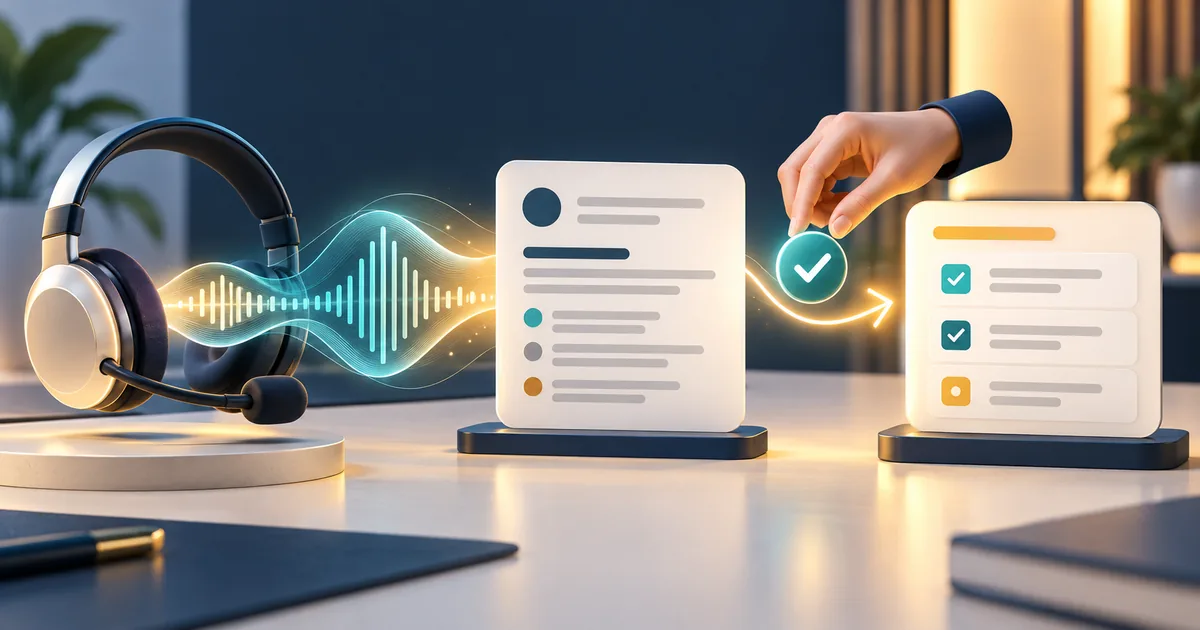
An AI-generated support-call summary is useful only when it helps the next person act correctly. A fluent paragraph that misses the customer’s unresolved problem, invents a deadline, or assigns a promise to the wrong speaker is worse than a short human note. The design goal is a reviewable record of the customer’s request, verified facts, work already done, and the next action—not merely a shorter transcript.
This guide begins after audio has been captured and a usable transcript exists. If the hard problem is speech recognition, speaker separation, or Persian transcription quality, start with the Persian speech-to-text guide. Here the question is how to turn a conversation into a reliable support record. In the Google Cloud Contact Center documentation, an agent can see a generated summary during wrap-up and submit it with their own notes. That is an example of a product workflow, not evidence that every generated summary is accurate without review.
Define the record before choosing a model
A support summary should separate four things: what the customer says happened, what the representative verified, what was done during the call, and what remains to be done. Add an owner for the next action and a due date only if one was explicitly agreed. “We will investigate” is not a promise that the issue will be resolved tomorrow. If a call covers two issues, record their states separately so one completed task does not obscure another open one.
Include identifiers such as an order or case number only when they are needed for follow-up and can be checked. Avoid copying unrelated sensitive details into the summary because they appeared in the transcript. The record should make a later handoff easier while exposing no more information than the recipient is authorized to see.
Design an explicit audio-to-case workflow
Separate ingestion, transcription, speaker attribution, sensitive-data handling, draft generation, agent review, and case submission. Each stage needs its own failure state. If transcription is partial or unavailable, the system should not silently produce a confident final note. Show the draft as incomplete and let the representative inspect the original material or enter a manual note.
Generating a summary and changing the CRM are different actions. The assistant may suggest a case category or priority, but opening a ticket, changing a customer record, or sending a message has operational consequences. Unless the organization has approved precise automatic conditions, treat model output as a proposal and let an authorized person confirm the action. Where automatic submission is necessary, make the rules testable and preserve a way to correct mistakes.
Treat transcription errors as summary risks
Customer names, order identifiers, amounts, dates, product names, and negatives such as “did not arrive” are easy to mishandle in noisy calls. A summarizer can conceal a transcription error behind polished language. Compare sensitive fields with an authoritative record or ask the agent to confirm them. If verification is impossible, mark the field unknown rather than filling it with a plausible guess.
Speaker attribution matters just as much. “I will call tomorrow” means something different when said by the customer rather than the representative. Transferred calls, interruptions, and multiple agents create additional ambiguity. Include those cases in acceptance testing. The target is not a perfect transcript for its own sake; it is a summary that does not turn an uncertain phrase into a false commitment.
Use structured fields and evidence links
A practical template might include topic, customer claim, verified finding, action taken, next action, owner, explicitly stated deadline, supporting transcript span, and unresolved uncertainty. Not every field must be filled. An honest blank is preferable to generated certainty. Map fields to the destination support system deliberately, with validation before any write operation.
For important statements, show the reviewer the relevant transcript segment or approximate recording time. That makes it quicker to verify a questionable claim. It does not remove the need to replay a sensitive segment or check the underlying order record. Long calls may need section-level processing, but the final summary must preserve the sequence of events, particularly when a decision changed during the conversation.
Make human review meaningful
The agent should see a concise, editable draft beside the evidence. Requiring them to rewrite a long generic paragraph defeats the point. At the same time, a blind “Approve” button is not a safety control. Record what the model proposed, what the agent changed, when the decision was made, and which version entered the case. This trace helps investigate errors and improve the system.
Flag higher-impact calls for a different review path: formal complaints, contractual commitments, security incidents, health information, or requests to delete data. Such cases may require specialist review or narrower access. This does not make AI assistance useless; it keeps draft generation separate from authority to decide. For ongoing sampling and correction after launch, the AI assistant monitoring guide covers a complementary operating process.
Set recording, access, and retention rules first
Before recording or processing calls, have legal counsel assess the applicable basis, notice, and consent requirements for the participants and jurisdictions involved. This article is not legal advice. Microsoft’s documentation on call recordings and transcripts notes that recording rules and consent requirements vary by location. Permission to record does not imply that every employee should see the audio or transcript.
Write separate retention and access rules for recordings, transcripts, summaries, and edit history. Decide who can retrieve each layer, when it is deleted, and what must be corrected when a source record changes. Test data should not be an unprotected copy of customer calls. If an external processor is involved, establish the data path and contractual controls before enabling the workflow.
Example: a delayed delivery call
Suppose a customer says an order has not arrived. The representative checks the order system and finds “handed to carrier,” not “delivered to customer.” They promise to ask the shipping team for an update but do not promise a delivery date. A useful draft preserves that distinction: customer reports non-receipt; system shows carrier handoff; a shipping follow-up was requested; no confirmed delivery deadline was given.
A poor summary might say “order delivered” after seeing the word delivered in the transcript, or invent a next-day arrival to sound helpful. The reviewer needs the original segment and order state to reject those errors. If the call concerns an existing case, attach the approved note to that case instead of creating an unnecessary duplicate.
Run a pilot on representative conversations
Include short and long calls, multi-topic conversations, noisy audio, and transfers. For each case, a reviewer should check whether the issue, finding, action, owner, and deadline are correct; what was omitted; and what, if anything, was invented. Do not claim a universal time saving before measuring it. Useful pilot measures include agent edit time, draft rejection rate, and severity of errors in operational fields.
Test the failure path too: missing audio, partial transcript, identity mismatch, invented date, or a failed CRM write. The agent should know what happened, and the system should not leave a half-written case without a clear recovery path. Decide in advance what would justify continuing, revising, or stopping the pilot.
Segment results by more than call length. Issue type, audio quality, speaker count, and whether a commitment was made all affect risk. A system can look strong on routine inquiries and fail on a transferred complaint where two representatives discuss different deadlines. Use the results to set a permitted scope. Routine calls may be ready for a reviewed draft while contractual or complaint calls remain under stricter human handling.
The next step
AI call summaries become an operational service when transcription is good enough, claims are distinguished from verified facts, an authorized person reviews consequential actions, and the approved record lands in the right case under a clear retention policy. Begin with one call type and a narrow template, then expand using observed errors and representative feedback. This is an experimental content topic connected to EasySaz services, not a claim of newly proven Search Console demand.
For a workflow that connects call processing, review, and a support system, EasySaz AI solutions is the relevant service page. You can contact the team with the call type, where recordings are stored, and the destination system so an acceptance test can be defined before implementation.