Until recently, AI in business meant a chatbot: you asked a question and got an answer. A new wave has arrived that is fundamentally different — agents. An AI agent does not just answer; it does the work — several steps in a row, connected to your systems, until the job is done.
The distinction sounds subtle but changes everything in practice. A question-and-answer assistant tells you "this item is running low"; an agent drafts the purchase order, finds the supplier and waits for your approval. This guide explains what an agent really is, how it works, where it is worth it, where it is dangerous, and how to start if you want to build one for your business.
What an AI agent actually is
An agent is a system that takes a goal, breaks it into smaller steps, decides for each step what needs doing, uses the tools available to it, and keeps going until it reaches a result — without you having predefined every move.
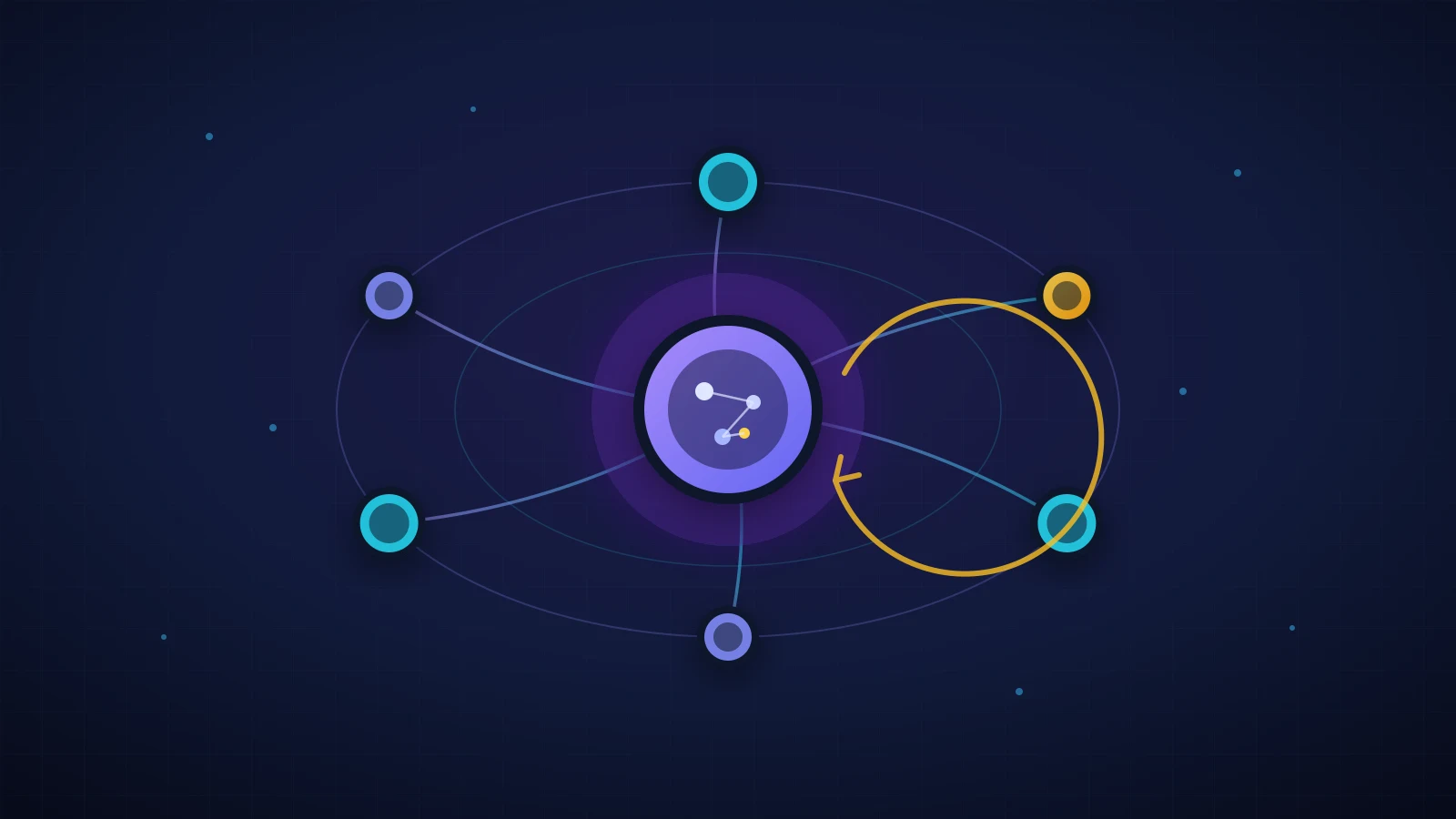
The key difference from a chatbot is the loop. A chatbot takes one input and produces one output; done. An agent works in a loop: it observes the state, decides, acts, evaluates the result and decides again. That loop is what lets it carry out multi-step work — and it is also exactly what makes it need careful containment.
Agent vs chatbot vs simple automation
Three things that are constantly confused:
A chatbot is conversation-driven. You ask, it answers; its memory is limited to that conversation and it does nothing in the outside world. We covered its cost and build logic in how much a Persian AI chatbot costs.
Traditional automation is rule-driven. "If this, then that" — precise and predictable, but helpless when it meets a situation you wrote no rule for.
An agent is goal-driven. Instead of a predefined rule, it takes a goal and builds the path itself. That flexibility is its main strength and, at the same time, its main risk.
An important note: goal-driven is not always better. For a process whose rules are clear and stable, traditional automation is cheaper, faster and more reliable. An agent earns its place where the path is not known in advance.
The building blocks of an agent
Every working agent is made of several parts, and the common mistake is reducing it to "the language model".
The deciding brain
The language model that understands the goal and decides the next step. This part reasons, but should not be trusted with deterministic arithmetic or final authorisation.
Tools
The agent's hands. Anything the agent can do in the real world — searching a database, sending an email, recording a row, calling a service — is a defined tool. The agent can only reach the tools you explicitly gave it; that boundary is the first layer of security.
Memory
What the agent needs to remember between steps: earlier results, collected data and the context of the work. Without proper memory, an agent gets lost in long tasks.
Control and permission layer
The rules that decide where the agent may act on its own and where it must wait for human approval. This layer is the difference between a trustworthy tool and an uncontrolled risk.
Real business use cases
Let us step away from abstraction. These are the use cases that pay off in practice:
Multi-step customer support
Not just answering a question, but following through to resolution. The agent checks order status, finds the cause of the problem, proposes a fix, and escalates to a human when needed — all in one flow.
Processing and routing inbound documents
Receiving an invoice or contract, extracting the data, matching it against the system and filing it in the right place. This is a natural extension of intelligent document processing, except the agent not only reads but decides where the document goes.
Research and information gathering
Reviewing several sources, putting findings together and producing a summary — work that takes hours by hand.
Internal operations assistant
An agent connected to internal systems that handles staff's repetitive work. This is the same logic we pursue in AI business process automation, but with more room to act.
The architecture of an agent-based system
A working architecture usually has these layers:
Goal and planning layer
Where the user's goal becomes a set of steps. The quality of this layer decides whether the agent acts intelligently or gets stuck in useless loops.
Tool and integration layer
Connections to the organisation's existing systems: finance software, CRM, inventory. Like any custom enterprise software project, this layer takes the most time and creates the most value.
Control and supervision layer
Limits, ceilings on permitted actions, and the points where the agent must stop and wait for approval. Without this layer, one small error can produce dozens of wrong actions in a row.
Logging and traceability layer
Recording every decision and every action the agent takes. When the agent acts on its own, being able to review "why did it do that" is no longer a luxury; it is a necessity.
How to contain an agent — this is the real problem
An agent's power lies in its autonomy, and its danger lies in exactly the same autonomy. An uncontained agent can, from one wrong reading, build a chain of wrong actions. Proper containment comes from these principles:
Least privilege
The agent should only reach the tools its specific task requires, no more. An agent whose job is summarising should not have the ability to delete records.
Human approval at sensitive points
Any irreversible or costly action — a payment, sending to a customer, deleting data — must sit behind a human approval point. The agent proposes; the human confirms. This principle is the backbone of AI Manager: sensitive decisions always require the owner's explicit approval.
Ceilings and an emergency stop
Limits on the number of actions, the budget consumed and the run time. If the agent gets stuck in a loop or steps out of bounds, a mechanism has to stop it.
Separating data from instructions
An agent that reads external content is exposed to input manipulation: text that tries to rewrite the agent's instructions. Input data must never be executed as a command.
Security and data privacy in agents
Because an agent acts on its own and connects to systems, it has a larger attack surface than a simple chatbot. A few points to design in from the start:
Every tool you give the agent is a door into your systems, so tools must be minimal, specific and narrowly scoped. The "read order" tool should not be the same one that also "changes an order".
The agent's access should be tied to the permission level of the user who invoked it. If an employee cannot reach some data, an agent working on their behalf should not see or change it either. Ignoring this is the most common route to data leakage in agent-based systems.
And finally, every input from the outside world — an email, a document, a customer message — must be treated as data, not a command. Separating those two is the boundary between a secure agent and a manipulable one. These are the same principles we stressed in private AI deployment.
What it costs to build an agent
An agent costs more than a chatbot because it does more. The real line items:
- Designing and implementing the agent logic and the planning layer.
- Building the tools and integrating with existing systems — usually the largest part.
- The control, permission and logging layer.
- Model processing cost, which — because the agent takes several steps — is higher per task than a single question.
- Ongoing maintenance and monitoring of decision quality.
The honest comparison is this cost against the value of the work the agent does — not against the price of a simple chatbot. An agent pays off where it reliably and scalably handles a multi-step, repetitive task that eats human time.
When you do not need an agent
Honestly: agents are fashionable, and that means they sometimes get used where they should not. Do not reach for an agent when:
- Your process has clear, stable rules; traditional automation is cheaper and more reliable here, and an agent only adds risk.
- Your task is simply question-and-answer over internal knowledge; a simple assistant is enough and you do not need an agent's decision loop.
- The cost of a wrong action is high and you have no control and logging infrastructure yet; those layers have to come first.
- Volume is low and irregular; the cost of building and maintaining an agent is justified only when the work is repetitive and frequent.
A simple rule: if you can write the whole path as rules in advance, you do not need an agent. Agents are for where the path varies and a decision is needed in the moment.
Success metrics
With an agent that has no metrics, you cannot tell whether it helps or creates trouble. Measure these from the start:
- Rate of successful task completion without human intervention.
- Escalation rate to a human and its reasons; high escalation means the agent is not ready, zero escalation may mean it has too much authority.
- Action accuracy: what share of actions were correct.
- Time saved in the specific process.
- Number of cases needing manual correction after the agent acted.
Common mistakes
- Starting with a goal that is too open; an agent works well on a narrow, defined task, not on "everything".
- Giving too much authority from day one; the agent should earn trust step by step.
- Having no logging and traceability layer, which makes debugging impossible.
- Handing deterministic calculations to the model instead of code.
- Forgetting failure modes: when a tool does not respond or data is incomplete, the agent must behave safely.
- No evaluation set, judging quality from a few lucky samples.
A roadmap for building an agent
- Step one: pick a specific, repetitive, effortful task whose path is not entirely fixed.
- Step two: define the necessary tools and build the agent with least privilege — at first it only proposes, it does not act.
- Step three: build an evaluation set and measure decision quality.
- Step four: add the control, permission and logging layer.
- Step five: pilot under full human supervision; the agent proposes, the human confirms.
- Step six: with earned trust, gradually increase authority on low-risk tasks.
This order deliberately starts with "least authority". Trust in an agent must be earned, not assumed.
How EasySaz approaches it
We design agents with a clear boundary between what the model decides and what deterministic code controls, and we place every consequential action behind an approval point or a controlled permission. If you are not yet sure whether your task needs an agent or a simple assistant is enough, the AI business assistant guide is a better starting point, and our services are detailed in AI solutions for business.
Frequently asked questions
How is an AI agent different from a chatbot?
A chatbot answers; an agent does work. A chatbot takes one input and gives one reply, while an agent takes a goal, breaks it into steps, uses tools and takes several actions in a row until it reaches a result. For simple question-and-answer tasks, a chatbot is enough and cheaper.
Does an agent work without human supervision?
In a proper design, not fully. The agent handles low-risk work on its own, but every sensitive or irreversible action sits behind a human approval point. You set the degree of autonomy, and it is better to increase it gradually.
How long does it take to build an agent?
It depends on the number of tools and the complexity of the integration. A simple agent with a few defined tools can be pilot-ready in a few weeks; an agent integrated with several enterprise systems takes longer. Our advice is to start small and expand gradually.
Does an agent work well in Persian?
The agent's decision-making depends on model quality in Persian, and today's models are far better at this than before. But the final quality depends more on tool design and the control layer than on language alone.
Does an agent replace human staff?
In practice, an agent takes over repetitive, multi-step work so people can focus on decisions and exceptions. A proper agent design keeps the human at the sensitive points rather than removing them.
Conclusion
An AI agent is the step after the chatbot: from answering to doing. That is real power, but it only pays off when paired with proper containment — least privilege, human approval at sensitive points, and full logging. An agent without those boundaries creates more trouble than help.
If you want to know which process in your business is a good candidate for an agent and which is better solved with simple automation, book a free consultation. We will review your processes and tell you honestly where an agent is worth it and where it is unnecessary spending.
Define execution boundaries before selecting a tool
When an agent will act inside business software rather than merely answer questions, first define where it must stop and who remains responsible. The human-in-the-loop automation guide helps structure those review points. Then use the AI vendor selection guide to turn capabilities, acceptance tests, and data requirements into verifiable criteria. An impressive demo does not replace testing on your actual workflow.