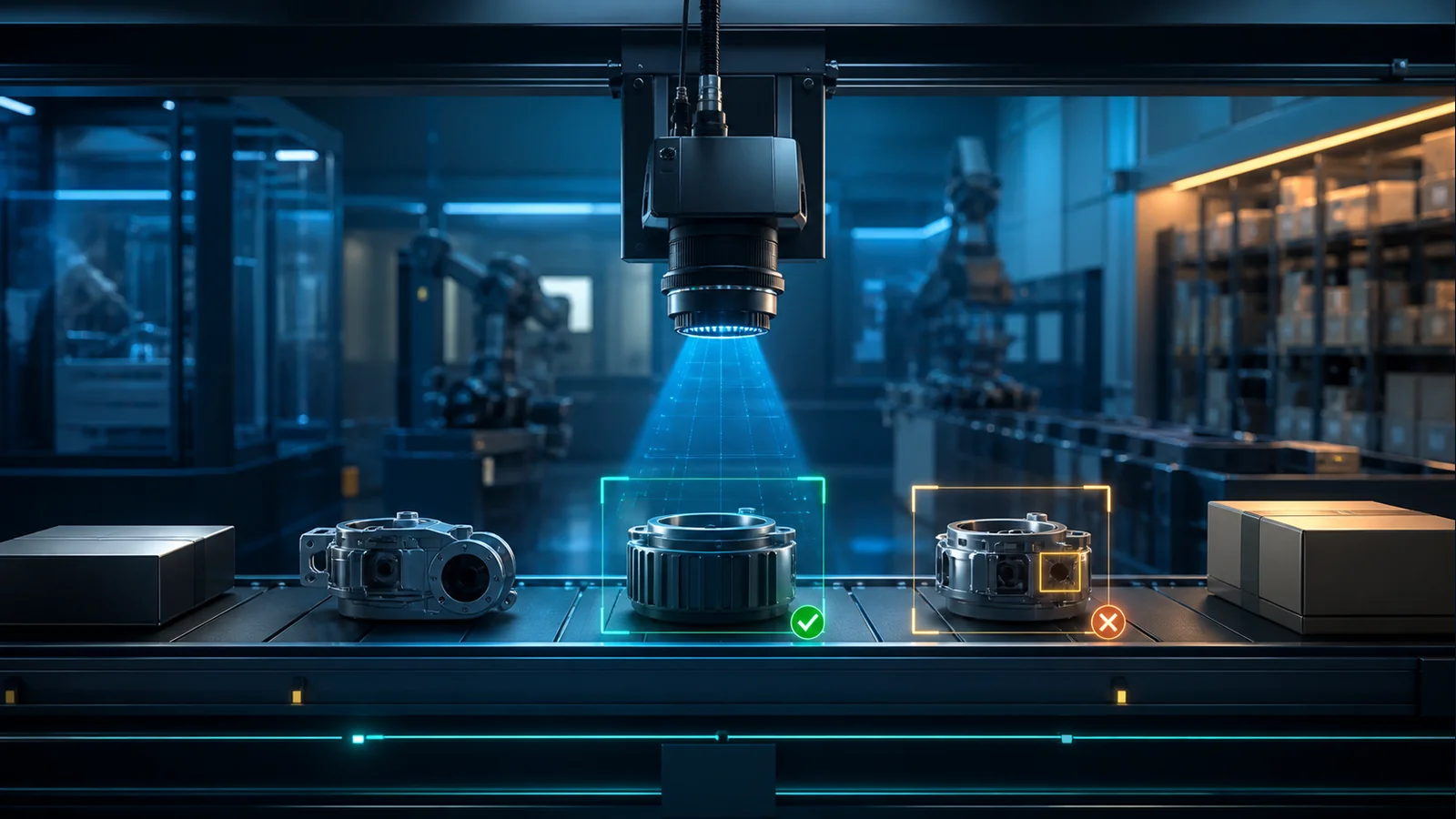
A camera records pixels. A business computer-vision system turns those pixels into a decision: accept or reject a product, count a package, flag an unsafe condition, extract a label, or send an uncertain case to a specialist. That connection between observation and action is where commercial value appears.
This guide does not repeat the general introduction in Machine Vision in Artificial Intelligence. It focuses on business selection and delivery: which use case is worth funding, what camera and data it needs, how performance should be measured, what determines cost, and how a small pilot becomes a dependable operational system.
What computer vision means for a business
A typical system has four stages: image capture, preprocessing, inference, and action. Cameras and lighting create a stable image; software prepares it; a model detects the required condition; and business logic sends the result to a dashboard, PLC, warehouse application, or human-review queue.
Detection alone is not an outcome. Finding a surface defect without identifying the product, recording the event, or triggering review is only a technical demonstration. The project must define the operational decision before choosing a model.
Classification, detection, segmentation, and OCR
Classification assigns one label to an image, such as acceptable or defective. Object detection identifies several objects and their locations with bounding boxes. Segmentation separates exact regions at pixel level and supports area or shape measurement. OCR extracts text from an image.
Choose the simplest method that supports the decision. A binary acceptance check may not need segmentation. Measuring a crack or leak may require precise localization. Labels, invoices, and serial numbers may be better handled through the practices in intelligent document processing.
Quality inspection use cases
Visual inspection can check surface condition, packaging, printing, assembly completeness, component presence, and product orientation. A system may identify a missing fastener, color variation, broken edge, damaged seal, or incorrect label.
The primary outcome is not model accuracy by itself. Measure scrap, rework, complaint, inspection time, and escaped-defect rates. AI in quality management provides the wider process context; computer vision is one tool inside corrective action and quality governance.
Counting, inventory, and logistics
Vision can count packages on a conveyor, estimate shelf occupancy, record pallets, or verify loading. Reliability depends on occlusion, camera angle, motion, lighting, and packaging variation being represented in test data.
Computer vision usually complements identifiers and barcodes rather than replacing them. When inventory accuracy is the objective, outputs should connect to warehouse records and the rules described in the AI inventory management guide.
Safety and process monitoring
A system can flag entry into a restricted area, missing protective equipment, or an obstacle left in a route. It should not become the only safety control. Occlusion, unusual clothing, poor light, and camera failure can create false negatives.
Human-related use cases require stricter privacy decisions. Define the problem around an operational event instead of identity whenever possible. AI applications in security discusses the broader security context.
Retail and service operations
Anonymous queue counting, shelf-gap detection, occupancy measurement, and layout checks can inform staffing and replenishment. The objective should not be unnecessary customer tracking. Many useful questions can be answered through local processing and non-identifying counts.
Service workflows can also use images to check documents, recognize item types, verify delivery condition, or guide an operator. Consent, retention, and role-based access must be defined before data collection begins.
Selecting the right use case
A strong first use case has repeated volume, a visible cost of error, and an actionable result. An inspection performed once a month or a defect that experts cannot consistently define is a weak starting point.
Score candidates by operation volume, error cost, image availability, labeling feasibility, integration difficulty, and process ownership. High-value problems with moderate complexity are usually better pilots than highly ambitious projects. AI data analytics helps establish the baseline needed to prove impact.
Define KPIs before selecting a model
Technical metrics can include precision, recall, and F1. Precision asks how many alerts were correct; recall asks how many real cases were detected. Quality inspection should also report false rejection of good products and defects that passed through.
Business metrics belong beside model metrics: inspection time, waste, rework, downtime, claims, or cost per unit. A slightly less accurate system may create more value when it is faster and cheaper. The final metric is operational impact, not an isolated benchmark.
Cameras and lighting are part of the model
Higher resolution is not automatically better. The smallest required detail, field of view, distance, line speed, and motion determine the camera. Stable lighting, a controlled background, and vibration-resistant mounting often improve results more than changing algorithms.
Collect examples across real conditions: shifts, operators, seasons, dust, product variants, and equipment aging. Data captured only under ideal conditions can produce a successful laboratory test and a failed deployment.
Training data and labeling
Models need consistent examples of acceptable and unacceptable cases. A labeling guide should define defect boundaries, severity, ambiguous cases, and how expert disagreement is resolved. Keep a separate test set that represents future operational conditions.
Rare defects are difficult. Targeted sampling, carefully controlled synthetic data, or anomaly-detection methods may help, but validation must use real images. A large class imbalance should never be hidden behind overall accuracy.
Edge or cloud processing?
Edge processing runs the model near the camera. It suits low latency, unstable connectivity, and policies that restrict image transfer. Cloud processing supports central management, flexible scale, and simpler retraining. Many systems are hybrid: local inference with central reporting or training.
The decision depends on bandwidth, response time, data policy, and maintenance capability. When images must remain inside private infrastructure, review the options in the private AI deployment guide early.
Dependable architecture and human review
An operational architecture includes cameras, preprocessing, model serving, a rules engine, event storage, a dashboard, and connections to current applications. The workflow needs a fallback; a model outage should not stop the entire operation.
Early versions should route low-confidence cases to specialists. Store the human decision as feedback for future improvement. After performance is proven, automation can expand. AI business process automation and AI agents for business provide useful patterns for multi-step coordination.
Privacy, security, and risk management
Store only images required by the objective. Face or license-plate masking, local inference, short retention, encryption, and role-based access can reduce exposure. Model versions, configuration changes, and important decisions should be auditable.
NIST's AI Risk Management Framework emphasizes validity, safety, transparency, privacy, and ongoing risk management across the lifecycle. Testing before launch is not enough; changes in lighting, products, or surroundings can reduce performance later.
What determines implementation cost?
Cost includes cameras and lighting, installation, data collection and labeling, model work, edge devices or servers, application integration, dashboards, user training, and maintenance. Inexpensive hardware that creates unstable images can multiply software costs.
Camera count is only one factor. Product variation, line speed, defect rarity, required accuracy, and the cost of downtime often matter more. A preliminary estimate can begin with the software pricing tool, followed by a defined scope for custom software development.
A 90-day pilot roadmap
During the first two weeks, define the use case, baseline, KPI, and defect criteria. The next weeks cover temporary camera installation, sampling across real conditions, and label-quality review.
In month two, build a baseline model and compare it with the current process. Configure thresholds, human review, and limited reporting integration. In month three, run the pilot on a controlled part of operations and measure error cost, speed, and stability.
Expand only after value and maintenance responsibility are clear. EasySaz AI solutions can stage the work from feasibility assessment through operational integration.
Common causes of failure
Projects fail when teams begin with a model instead of a decision, use idealized images, ignore false rejects, or automate before human review is ready. Another common mistake is assuming one threshold works across every product and environment.
Long-term failure often comes from missing monitoring. A new package, shifted camera, dirty lens, or seasonal light can change input data. Quality drift needs an owner, alerts, and a retraining or rollback procedure.
Frequently asked questions
Does computer vision replace quality inspectors?
It usually handles repeated checks first and routes uncertain cases to experts. Human work shifts toward criteria, exceptions, root-cause analysis, and process improvement.
How many images are required?
There is no universal number. Variation, class count, defect rarity, and label consistency matter more than raw volume. A short data study should determine readiness.
Can existing cameras be reused?
Sometimes, when resolution, frame rate, angle, and technical access are adequate. Test the smallest required detail under real motion and lighting before deciding.
What accuracy is acceptable?
It depends on the cost of false positives and false negatives. A safety case may prioritize recall; rejecting an expensive good product may require stronger precision.
When is a pilot successful?
When technical metrics and a business KPI—such as inspection time, waste, or error cost—improve while the system remains stable in real conditions.
Conclusion: connect the camera to a measurable decision
Computer vision creates value when the problem is bounded, imaging is stable, metrics are agreed, and output is integrated with operations. Buying a camera or training a model without a decision and KPI usually produces a demo rather than a business capability.
Start with one repeated, measurable use case, keep people in the loop, and evaluate error cost alongside accuracy. Expand infrastructure and automation only after the pilot proves value.
Official references: Google Cloud Vision feature list, Microsoft Azure Vision object detection, and the NIST AI Risk Management Framework.